Before the Telescope: How People Kept Track of the Sky
Before the telescope, people tracked the sky by watching repeatable patterns, marking seasons, and keeping records—methods you can try with simple observations.
The common mistake in imagining astronomy before the telescope is to picture people staring up without a plan. That misses the work: they watched familiar parts of the sky return, connected those appearances to seasonal changes, and kept records that made the next observation easier to interpret. Before the telescope, keeping track of the sky meant building a dependable habit with unaided eyes, memory, landmarks, and marks on a surface.
You can try a small version of that practice without pretending to recreate any one ancient culture. The point is not to identify every object or recover a lost calendar. It is to see how repeated observation turns a shifting sky into a pattern you can describe and compare.
Choose one question the sky can answer
Start with a question narrow enough to revisit. A broad one—“What is happening in the sky?”—offers too many moving parts. A useful question might be: Where does the Sun set as the weather changes? Which bright stars appear after dusk in one part of the year but not another? At what point in its repeating cycle does the Moon appear on a chosen evening?
People in different places and periods had different reasons to watch. Seasonal work, travel, ceremonial observances, and the organization of time could all make recurring celestial appearances significant. Avoid assuming that every community watched the same objects for the same purpose. A sky record makes most sense alongside the needs and surroundings of the people who made it.
For a simple observing project, choose one visible feature and one local landmark. A rooftop edge, distant hill, or tree can help you describe where something appears, but the landmark is a reference, not a universal measuring instrument. The visible horizon changes from place to place, and buildings or trees can hide part of it.
Make a record before relying on memory
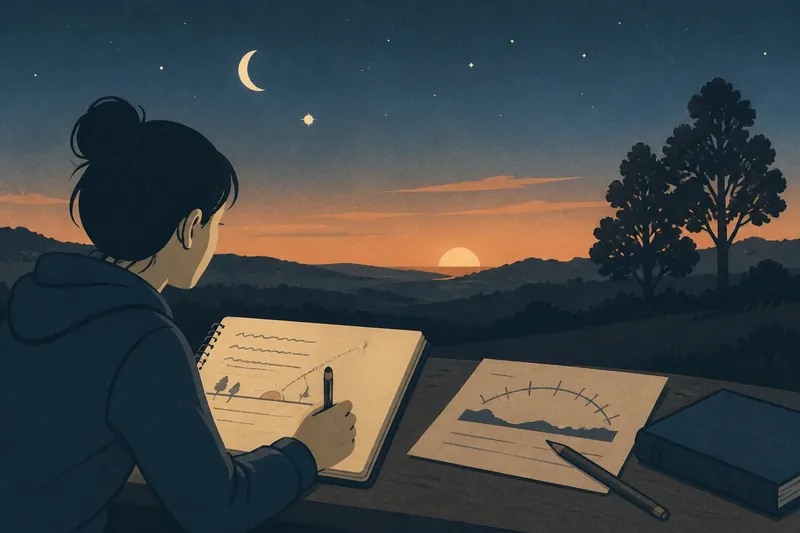
Write down what you actually see, not what you think ought to appear. A notebook entry can include the date, approximate time, weather, your location, the direction you faced, and a plain description. Add a sketch if it helps: show the horizon line and mark where the object appeared above it. You do not need a star chart to begin.
Keep the description consistent. “Bright point above the roofline, toward the west” is more useful for comparison than “beautiful evening sky.” If clouds block the view, record that too. A gap in observations is part of the record, not a failure to observe.
Different societies used different forms of sky records, including oral knowledge, calendars, written notes, diagrams, and built features aligned with particular directions or appearances. These forms are not interchangeable. An oral tradition can preserve knowledge through shared practice; a written record can leave marks for later comparison; an aligned structure can connect a place with a recurring sight. Each calls for care in interpretation, rather than a quick assumption about what its makers intended.
Compare appearances across a repeating cycle
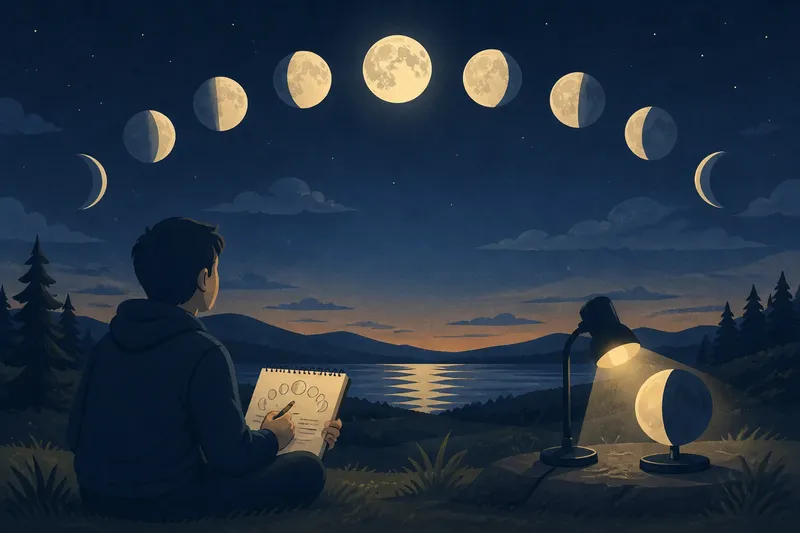
Once you have a few entries, look for recurrence rather than dramatic change. Does the same bright star appear at a similar part of the evening after a stretch of time? Does the Moon return to a familiar phase? Does the sunset point shift along the horizon as seasons pass? These are different cycles, and they do not all repeat at the same pace.
Take care with the word “same.” A star can appear in a different position during the night as Earth turns, while its seasonal appearance at a given time shifts over longer intervals. The Moon changes its visible shape through its cycle and also moves against the background of stars. A record that notes time and direction helps keep these motions from being confused.
Imagine you record the sunset’s position against a gap between two distant trees on several clear evenings. Over time, the setting point appears to move along the horizon, then reverse its direction of travel. The useful observation is the repeated shift, not an exact date or a claim that the trees mark a universal seasonal boundary.
Use landmarks carefully and keep the place attached
A horizon is local. A mountain ridge, coastal edge, or line of buildings can make observations easier to repeat, but the same celestial event may look different from another location. Even nearby observers may have different obstructions. Record where you stood and what blocked your view so someone reading the notes can understand the limits.
Some communities made enduring connections between sky events and places. A structure’s orientation may invite questions about the Sun, Moon, or stars, but orientation alone does not settle what people observed or why. The surrounding landscape, local knowledge, and repeated use matter. Treat a proposed alignment as a question to investigate, not a complete explanation.
It is not worth forcing every observation into a neat pattern. Clouds, uneven horizons, mistaken identifications, and inconsistent timing can muddy a record. The practical response is to describe the uncertainty plainly and keep watching when conditions allow.
Turn separate notes into a shared record
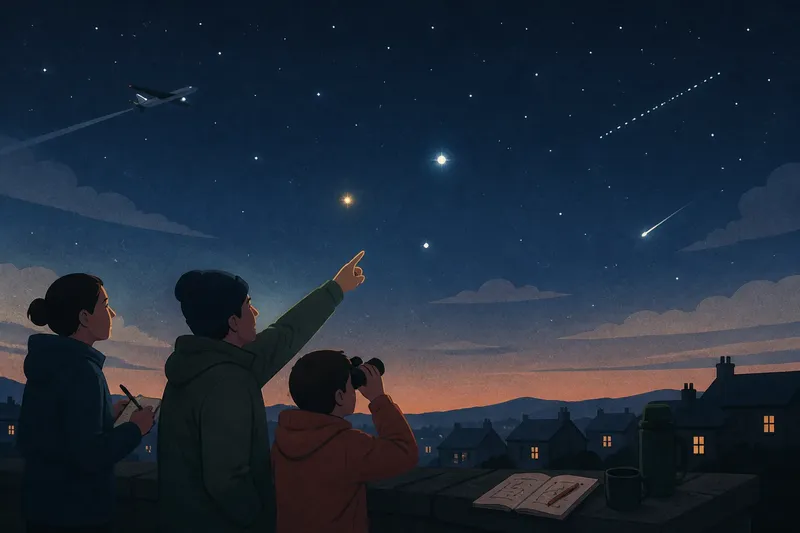
Compare observations only after you know what each person recorded. Agree on simple terms for direction and appearance, and note whether “evening” means just after sunset or later in the night. A group can use a paper map of the horizon, a shared notebook, or a plain calendar. The tool matters less than making entries understandable to someone who was not there.
Say your group meets at a park and one observer records a bright object above the western treeline while another sees nothing from behind a building. The first entry should include the open view and approximate time; the second should note the obstruction. Together, those notes explain the difference without treating either observer as careless.
When you compare records, separate what was seen from what was inferred. “A bright point appeared before the nearby stars” is an observation. “It marked the start of a season” is an interpretation that may depend on local practice and historical context. Keeping those statements distinct makes the record more useful and respectful.
What can a sky record tell us?
How did people track the sky without telescopes?
They could observe the unaided sky repeatedly, remember recurring appearances, and preserve knowledge through oral traditions, calendars, notes, diagrams, or place-based markers. The specific practice varied with community, environment, and purpose.
Which patterns are easiest to notice with the naked eye?
The Moon’s changing appearance, the Sun’s changing position at the horizon, and the return of familiar stars are accessible starting points. Clear descriptions and repeated observations matter more than trying to name every object.
Did ancient structures function as calendars?
Some structures may relate to celestial directions or recurring appearances, but an apparent alignment does not by itself establish a calendar or explain its use. Interpretation depends on evidence about the place, its makers, and the practices connected with it.
How can I start my own sky record?
Choose one question, use the same viewing place when possible, and write down the date, approximate time, weather, direction, and visible details. Add a sketch or a note about obstructions, then compare entries only after you have a useful sequence.
Let the record stay modest and specific
A sky journal is not a contest to collect the most sightings. A short series of careful notes can reveal how observation becomes knowledge: a recurring appearance is noticed, described, compared, and given meaning within a particular place and way of life. That sequence is the heart of keeping track of the sky before telescopes, and it remains a satisfying way to look upward now.
For your next entry, keep the question small and the wording plain. The phrase “before the telescope” names a broad span of human practice, not a single method; your notes can honor that variety by recording what your own sky shows without claiming to speak for everyone who watched before you.