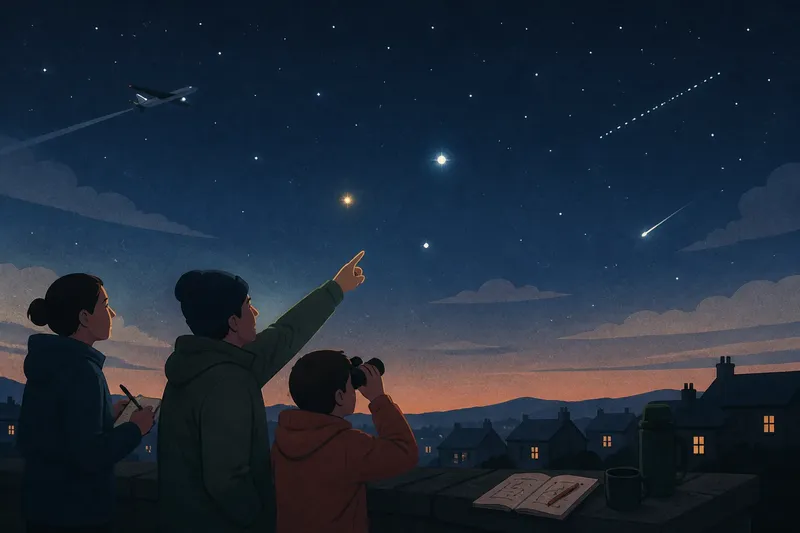
Binoculars or a Small Telescope for a First Look?
Compare binoculars or a small telescope by view, handling, and setup so your first observing tool fits the targets you want to find and follow.
The most common mistake when choosing binoculars or a small telescope is treating magnification as the whole story. For a first look, the instrument’s field of view, support, and way of aiming shape what you can actually find and follow.
Choose by the kind of sky you want to examine
Binoculars show a broad patch of sky with an upright view through two eyepieces. They are useful for tracing a pattern from one star to another, comparing nearby stars, or taking in a bright cluster with the surrounding sky still visible.
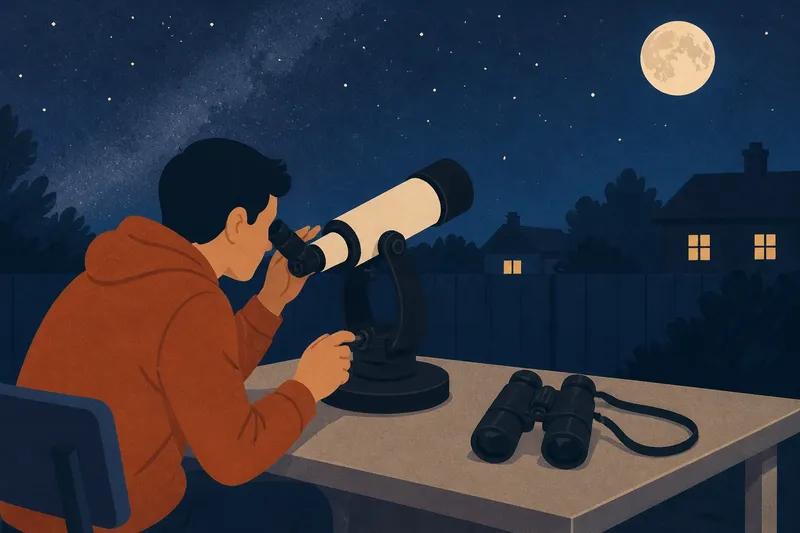
A small telescope brings the view through one eyepiece and aims with a mount. Because it usually shows less sky at once, it asks you to locate a target and settle on it. That makes a telescope a natural fit for close attention to a particular lunar feature or another compact target.
Field of view means how much sky appears in the eyepiece at one time. A wider view gives you more nearby stars as landmarks; a narrower one makes a smaller area easier to inspect once you have found it. Neither view is automatically better. The useful question is whether you want to map a region or concentrate on a detail.
Binoculars make it easier to connect the stars
Handheld binoculars are quick to bring outdoors and straightforward to aim. Point them toward a bright landmark, look through the eyepieces, and adjust your direction. Their broad view can help you understand how a target fits into its surroundings instead of isolating it from the rest of the sky.
That freedom comes with a visible trade-off: hand movement shifts the scene. Resting your elbows on a chair or a steady railing can help. A tripod may steady larger binoculars, but it also adds setup and makes them less immediate to pick up and use.
For an evening of comparing broad star fields or sweeping along the Milky Way from a dark location, binoculars keep the neighboring patterns in view. They can also be passed between observers without having to reposition a mount, though each person may need to adjust the eyepiece spacing and focus.
A small telescope turns attention toward one target
A telescope’s mount supports the tube, so you do not need to hold it aloft. A lightweight mount can still wobble when touched or buffeted by a breeze, but a stable support helps keep the eyepiece view from shifting as readily as a handheld one.
A simple alt-azimuth mount moves up, down, left, and right. A tabletop model needs a firm surface at a comfortable height. A tripod mount offers more freedom in where you set the instrument, but its legs and tube need room and arranging them takes time.
Interchangeable eyepieces let you alter the view. A lower-magnification eyepiece generally shows more surrounding sky and can make it easier to locate a target. A higher-magnification eyepiece frames a smaller area, so small aiming errors become more noticeable. There is no need to change eyepieces on a first night just to make the session worthwhile.
Which instrument fits your first observing nights?
Which is simpler to carry outside?
Compact binoculars are usually easier to pick up and put away because they have no separate mount. For a telescope, account for the tube, mount, and any table or tripod needed to use it.
Which shows more surrounding sky?
Binoculars often show a broader area than a telescope used at higher magnification, which can help you recognize a target’s setting. Check the listed field of view for the specific instrument and eyepiece rather than assuming every model gives the same view.
Which is more useful for the Moon?
Binoculars can show a broad view of the Moon, while a telescope can frame a smaller region for closer inspection. The choice depends on whether you want the whole scene or a particular crater and the boundary between light and shadow.
Do binoculars need a mount?
Compact binoculars can be used by hand for short looks. If the view jumps around or your arms tire, try a stable support, keeping in mind that it adds equipment and setup.
Check your observing habits before choosing
- Check whether you want to scan star patterns or examine one target; if scanning matters more, favor binoculars, but if close attention to a small area matters more, consider a telescope.
- Check whether your arms can hold the binocular view steady; if the scene wanders or your arms tire, try bracing your elbows or consider a support, but if a support feels cumbersome, favor a lighter handheld pair.
- Check what surface a tabletop telescope needs; if you have a firm table at a comfortable height, it may fit, but if not, choose a model with a suitable tripod or consider binoculars.
- Check the telescope mount’s movements and stability; if it points smoothly and stays settled, it suits focused viewing, but if it shifts when touched, look for a more stable setup or choose binoculars for casual scanning.
- Check the field-of-view information for the specific binoculars or telescope eyepiece; if you want surrounding stars as guides, favor the broader listed view, but if you want a tighter look at a small feature, favor the narrower view.
- Check whether the instrument is comfortable to carry from your storage spot to where you observe; if the complete setup feels awkward, choose a simpler instrument, but if the parts are easy to handle, keep that option in consideration.
How do you match the instrument to a real evening?
What if I want to learn star patterns?
Choose a view that leaves nearby stars visible so you can compare their arrangement. Binoculars often suit this aim better than a telescope set to higher magnification.
What if I want to inspect lunar detail?
A telescope can frame a smaller lunar region more closely, while binoculars show more of the Moon at once. Decide whether the broad scene or a particular feature is the point of the session.
What if several people will take turns?
Binoculars are easy to pass around, but each person may need to adjust the fit and focus. A telescope can remain aimed on a target, though observers may need to reposition themselves at the eyepiece.
Say you have a firm backyard table, a bright Moon above the rooftops, and a plan to inspect one crater rather than map nearby stars. You compare the options: handheld binoculars would be quick to point but may show too much of the lunar disk for that purpose; a tabletop telescope has a suitable support surface and can frame the crater more closely. You set the telescope on the table, begin with its lower-magnification eyepiece to locate the Moon, then switch to a higher-magnification one if the mount stays settled and the target remains easy to follow. The resulting choice is the telescope for this particular session, with the trade-off of a narrower view and more setup.
Keep comfort and safe handling in the decision
Think about where you will sit or stand, whether you can brace your arms, and how easily you can carry the complete setup through a doorway or to a nearby park. Equipment that fits your usual observing place is more useful than a more elaborate arrangement that is awkward to bring out.
Follow the manufacturer’s directions for mounting, handling, and care, along with local rules at shared observing sites. Never point binoculars or a telescope at the Sun. Safe solar viewing requires equipment designed for that purpose and used exactly as directed.
Chasing the highest magnification printed on a box is not worth the effort before you know what kind of view you enjoy. If you can borrow an instrument or attend a community astronomy night, compare the broad surroundings in binoculars with the focused eyepiece view of a telescope.
When comparing binoculars or a small telescope for a first look, choose the view and setup that fit the targets you want to find and follow. That decision can change with the evening; one instrument does not have to settle every future observing choice.