Why the Moon Seems to Change Shape
Why the Moon seems to change shape comes down to sunlight and our viewpoint. Use a simple model to make each phase easier to understand.
The most common mistake about why the Moon seems to change shape is imagining Earth’s shadow slowly sweeping across it each month. That shadow matters during a lunar eclipse, but ordinary phases have a simpler cause: sunlight illuminates half the Moon, and as the Moon moves around Earth, we see different portions of that sunlit half. Keep that picture in mind and the crescent, half moon, and full moon become parts of one repeating pattern.
Start with three bodies and one steady light
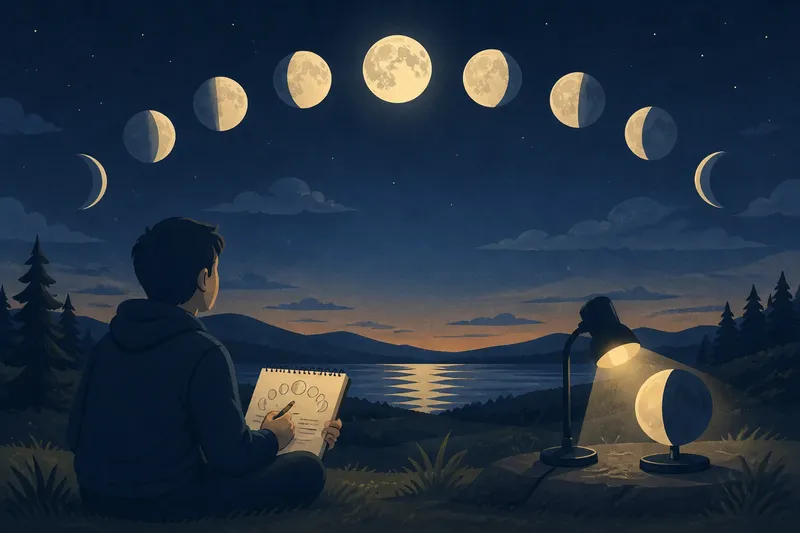
Use a lamp, a ball, and your head to build the mental model. The lamp stands for the Sun, the ball for the Moon, and your head for Earth. Dim the room if you like, then hold the ball out in front of you and turn slowly in place. Keep the lamp shining on the ball as you move.
The lamp always lights the half of the ball facing it. The half turned away stays dark. As you change your position, the boundary between those halves stays put on the ball, but your view of it changes. Sometimes you see mostly the lit side; sometimes mostly the dark side; sometimes a balanced slice of each.
That is the central idea: the Moon’s phases describe how much of its sunlit half is visible from Earth. The Moon is not changing shape, switching its own light on and off, or passing into Earth’s shadow during the ordinary monthly cycle.
Follow the changing view through one lunar cycle
Imagine starting with the ball between your head and the lamp. The lamp lights the side facing away from you, so the side you can see is mostly dark. This is the new moon arrangement. In the real sky, the Moon is near the Sun’s direction, which can make it hard to pick out in the bright daytime or twilight sky.
Now move the ball a little around you. A narrow lit edge appears from your viewpoint: a crescent. Continue around and the visible lit portion grows. At a quarter of the way around the circle, you see half of the Moon’s disk lit. This phase is called first quarter, even though it looks like a half circle from Earth.
As the Moon keeps moving, more of its visible face is sunlit. The shape is now a waxing gibbous Moon: “waxing” means the lit portion is growing, and “gibbous” means it appears more than half lit but not full. When the Moon is on the opposite side of Earth from the Sun, its near side is turned largely toward sunlight. We see a full moon.
After full moon, the visible lit portion starts shrinking. The Moon is waning. It passes through waning gibbous, third quarter, and waning crescent before returning to new moon. The names describe a continuous change, not a set of separate shapes the Moon somehow adopts.
Why the visible edge keeps moving
The changing boundary between light and dark on the Moon is called the terminator. It is not a shadow cast by Earth. It is the line separating the part of the Moon facing the Sun from the part facing away. From Earth, that boundary seems to travel across the disk as our viewing angle changes.
At crescent phases, the terminator curves around a slim lit portion. Near quarter phases, it cuts across the disk and makes the light-dark division look nearly straight. At gibbous phases, the terminator lies closer to the edge of the visible disk. The exact curve is shaped by the Moon’s round surface, even though the disk we see looks flat.
The Sun-facing half is illuminated at every phase. What changes is how that half lines up with our view. The lamp-and-ball model helps because it keeps those two ideas separate: illumination belongs to the Sun, while the phase depends on where you are looking from.
What questions help make the phases click?
Does Earth’s shadow cause the Moon’s phases?
No. The phases come from seeing different amounts of the Moon’s sunlit half as it travels around Earth. Earth’s shadow falls on the Moon only during a lunar eclipse, a distinct event rather than the cause of the regular phase cycle.
Why can I sometimes see a crescent during the day?
A crescent Moon can be above the horizon in daylight because it is not always close to the Sun’s direction in the sky. Its sunlit sliver can still be visible against the brighter sky, though its contrast may be subtle.
Why does a full moon rise around sunset?
At full moon, the Moon appears opposite the Sun in the sky, so it tends to rise as the Sun sets and set as the Sun rises. The exact timing shifts with the Moon’s motion and the observer’s location.
Why do the Moon’s phases repeat?
The Moon circles Earth, changing its position relative to Earth and the Sun. When it returns to a similar alignment, we see a similar amount of its sunlit half, and the familiar phase pattern begins again.
Use a short routine to learn the pattern
A week of small observations can make the model feel less abstract. You do not need a telescope or a carefully chosen site. A clear view of a safe patch of sky is enough; if clouds hide the Moon, use the lamp-and-ball model and resume when it returns.
- On the first clear evening, note the Moon’s apparent shape and where the lit side faces. A quick sketch is more useful than trying to memorize a phase name.
- On another evening, look again at roughly the same part of the day. Note whether the lit area appears to have grown or shrunk, and compare it with your earlier sketch.
- After a few days, repeat the comparison. Add the date and a simple label such as crescent or gibbous only if it helps you remember what you saw.
- When the Moon is difficult to see, place a ball in front of a lamp and move around it. Keep track of which side the lamp lights and which part your viewpoint reveals.
- At the end of the week, arrange the sketches in order. Look for the progression from a smaller visible lit portion to a larger one, or the reverse, rather than expecting the Moon to appear at the same time each day.
Say you begin with a thin crescent drawn in the lower corner of a notebook. A few evenings later, you add a wider crescent with its bright edge facing the same general direction. If you label the drawings with dates, the expected observable result is a record that makes the Moon’s growth in visible illumination easier to recognize, even if you miss a night.
Separate phase from the Moon’s tilt
The crescent can appear to curve upward, sideways, or at another angle in different parts of the sky and at different times. That tilt does not mean the Moon has changed which side the Sun lights. It reflects the orientation of the Moon’s path relative to your horizon and the direction you are facing.
This is why a drawing made from memory can be misleading: the familiar “smile” crescent is not a universal orientation. Sketch what you actually see, including the direction of the bright edge, then compare its illuminated area separately from its tilt.
It is also not worth spending time trying to make the lamp-and-ball setup reproduce every detail of the sky at once. The model is for understanding the changing fraction of the lit half, not for matching the Moon’s exact height, apparent size, or orientation from a particular place.
Keep one useful idea in view
Why the Moon seems to change shape has a compact answer: sunlight always lights half of the Moon, while the Moon’s journey around Earth changes how much of that half we can see. When a phase looks puzzling, return to the lamp, the ball, and your viewpoint. That simple geometry is enough to connect a bright full disk, a narrow crescent, and every stage between them.